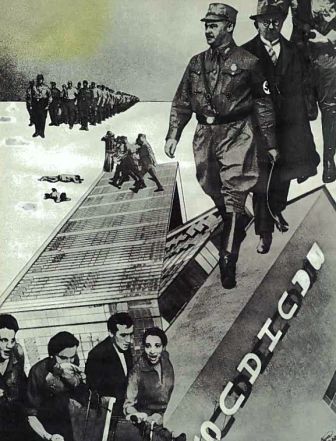
“The society which has abolished every kind of adventure makes its own abolition the only possible adventure.” Paris, May 1968


Friday, 25 May 2012

How I rode with Buffalo Bill.


When I was a little kid no publication gave me more pleasure than the Buffalo Bill Annual.  The wonderful  Denis McLoughlin art work, ripping yarns and factual articles all informed my view of the American West; far more than did film or TV.  I realised of course that times had changed, that the world had moved on, but I'm sure that to some extent I was convinced that the Wild West was still to be found by those prepared to saddle up and ride into the sunset.
In 1968 I finally did ride the western plains, but aboard a beat up Oldsmobile rather than a Quarter Horse. As we crossed the Arkansas - Oklahoma state line and headed west on Route 66 I became increasingly quiet, hardly speaking at all to my companions. Now it's true that at the time I was smoking dope on an  almost industrial scale but that was not the reason for my long spells of silence. I was simply totally poleaxed by the vastness of the landscape - and the fact  that somehow, rather like the English schoolboys who travelled through time to ride with Bill Cody in his Annual, I was here, actually in The West. Occasionally we would catch sight of a lone horseman topping a rise. The Indians tended to be manning filling stations rather than hunting buffalo or taking scalps but I never doubted for a moment that they could switch back to the lifestyle of their ancestors at the drop of a stetson.
Of course by this time I was well aware of the reality behind the myth of The West. The genocide that was at the heart of the Indian Wars, the poverty of the reservations, the fact that Hitler was a great admirer of the Manifest Destiny of westward expansion (for Sioux read Slav) and that as I pursued my childhood fantasy in Texas and New Mexico the real conclusion to all of this was being acted out in Vietnam. But like so many other things in life I discovered that the reality behind the myth was far and away more interesting than the myth itself - disturbing at times but interesting none the less. Looking for the image of the Buffalo Bill Annual on the net I found that it's possible to buy copies from the 50's. I wonder if I dare?

Thursday, 24 May 2012

Hitler's Children. A film to make your blood run cold.

Last night's BBC 2 documentary Hitlers Children was a chilling reminder that even the most terrible mass murderer is somebody's father or son or sibling. It was also one of the most moving films that I have seen for some time. At one level it was an investigation into how the children and grandchildren of Nazi war criminals coped with their dreadful legacy but it also opened a whole can of worms about national guilt, family loyalties and the real nature of evil. It was also an affirmation of the potential for human decency in the worst of times. Gripping stuff and as the first hints of a European unravelling emerge, subjects that we should all think long and hard about.

Tuesday, 22 May 2012

Social mobility - or masters without slaves?

We seem to be hearing a great deal about social mobility, or rather the lack of it, these days. The New Labour elite are a bit unsure about the whole concept and claim  to be in favour of old fashioned class pride and solidarity. Bit late for that you might think. Little Clegg thinks that it's a jolly splendid idea and that we could all do with a lot more of it. I imagine that David Cameron thinks that social mobility is a bit like time travel and just about as realistic. Meanwhile the Pol Pot school of thought on the subject is gaining ground in some quarters. Spiked's Brendan O' Neill thoughts are worth a look but as my own  small contribution to the debate can I just ask why it is that in post-Blair Britain an aspirational working class person is always assumed to be incapable of aspiring to anything beyond lining their own pockets?

Sunday, 20 May 2012

Map reading for beginners.

Maps do not of course come value free. That is to say that they are social products and as such are not only representations of the world but reflections of the ideas and aspirations of the map maker as well. I suppose that maps have played a far more important role in my life than they do for most people. Marine charts were a tool of the trade for much of my working life but even a day out is not complete for me without a map and at least some understanding of the local topography. But even for someone pretty clued up about maps and map making it's easy to fall into the trap of accepting the map as in some way "true". Cartographers have to make a huge number of decisions about what to include and what to leave out of a map as well as where to centre it and what projection to use and these decisions both reflect the map makers world view - and go toward shaping our own as well. If you doubt this just think back to the school atlas hanging on the classroom wall. The distortions of the classic Mercator projection give the impression that Europe and our tiny island are huge in comparison with equatorial countries and this combined with centring the map on the Greenwich Meridian ensured Britain's central position in the world for generations of schoolkids. On such assumptions an empire was consolidated.
In an effort to encourage Londoners to walk to work during the Olympics and ease the pressure on what will be a hopelessly overburdened transport system, TfL and Mayor for London have published a map displaying the walking times from Fenchurch Street Station.  Concentric circles radiate out from Fenchurch Street so we can see for example that both Bank and Liverpool Street are within the ten minute  radius, Tate Modern is within the fifteen to twenty minute zone and that Colombia Road Flower Market is way out on the twenty five minute line. It's a practical map and pleasing to the eye as well; but take a closer look. The map is not actually centred on Fenchurch Street but somewhere near Guildhall and this means that the distance rings come to an abrupt halt on the southern and eastern edges of the sheet. By situating places like Stepney and Walworth  beyond the pale, in some kind of City Hall terra incognita, we are given a distorted view of London and an insight into the thinking of those who run the capital as well. You can learn a lot from maps - and sometimes find more than just your way from A to B.

Friday, 18 May 2012

First cast the sarni from thy own bag.

Armed with a flask of tea and a bite to eat I set off this morning for a days work down the allotment. The bus was a bit crowded but I managed to find a seat and plonked myself down next to another passenger. The bus had hardly pulled away when I thought, "Bloody stroll on! What's that smell?"  Only later did I discover that the smell in question was actually coming from the Camembert sandwich in my bag. How easy it is to misjudge others.

Thursday, 17 May 2012

A man of principle.

The tangled web that is the Murdoch/Cameron/Brooks cabal continues to titillate us but such is the level of greed and corruption in 21st century Britain that only the most unworldly would be surprised at the daily revelations. The media, the political elite and the business class seem only too happy to feather their nests. It's safe in those nests - a bit smelly but safe. Years ago Jamie Reid told me that one of the things that he was most proud of was not the stuff we did in Wicked Messengers, his efforts in Suburban Press or even his iconic Sex Pistols art work. No, what Jamie was most proud of was his Dad who as City Editor at the old Daily Sketch had stuck to his socialist principles and refused to make a penny out of his inside knowledge of the markets. I fear that these days John Reid would be a laughing stock. I suppose things will get worse before they get better.

Tuesday, 15 May 2012

Bauhaus at the Barbican.


Just got back from the Bauhaus exhibition at the Barbican. This hugely influential school of art and design, like so much else that was progressive, challenging and fun during the Weimar years, would eventually succumb to the nazi jackboots. The simpletons of national socialism found Bauhaus too foreign, too modern and perhaps too Jewish. The legacy of the Nazi Party would be carnage on an unprecedented scale while that of Bauhaus was some beautiful ideas - and the nesting tables.